Internship Blog 8

Because of my internship, I have first hand experience working within a Smithsonian Institution. As a result, I’ve been able to collaborate and network with Smithsonian faculty. From these collaborations, I have been able to prototype and provide feedback on educational resources. In terms of networking, I have been able to meet individuals from the Center for Folklife and Cultural Heritage (CFCH), and the National Museum for the American Indian. 

As mentioned, I developed an educational prototype for CFCH. I used Canva to storyboard lesson modules for a lesson focused on culture. I created worksheets and modified existing article content from Folklife magazine. I was encouraged by my internship supervisor to write an article about my experience creating the prototype and submit it to the Journal of Folklore and Education (JFE). I managed to draft an article and I was able to submit it. Fortunately, the Journal of Folklore and Education is interested in publishing it after I make the necessary revisions. 

Most recently, I was assigned to provide feedback on the Center for Folklife and Cultural Heritage’s Cultural Vitality incubator. This project is designed to assist communities in the implementation of cultural festivals. I was selected to assist on this project due to how thorough I am with creating educational resources. I took a similar approach to the cultural vitality prototype. It was my responsibility to identify gaps in understanding. My recommendations consider participants who are complete novices to cultural vitality as well as participants foreign to the United States who may experience a language barrier.I recommend that universal designs for learning be used in the cultural vitality training. The inclusion of Universal Designs for Learning in teaching materials enable educators to fill in gaps for understanding. I recommended UDLS such as multiple means of representation such as specific images and visual examples, guided reading notes, a glossary, and a checklist for festival design.  I proposed the making of guided reading notes/worksheets that can be given to participants to allow them a way of following the slide presentation when attending the in-person training.  I noted that it would be helpful to have/distribute a glossary of important terms that make an appearance in the presentation. This glossary can be given once participants go through the initial training to have easy reference to terms and review what they learned and inform their colleagues. 

During my internship, I was able to network. I attended an open house back in January in relation to the CFCH. Throughout the second semester, I met with individuals from CFCH and NMAI. In two weeks, I will be meeting someone from the National Museum of American History. Most of the people I have met from NMAI deal with creating, prototyping, writing and implementing educational content. These roles include museum program specialists, teacher services coordinator, educational specialists, and UX designers. I am making steps to leave my role as educator so it was a great help to see what types of jobs exist in SI education.
Internship Blog 7

Working in the digital public humanities requires creativity, research, innovation, prototyping and testing. I was reminded that it is necessary to be creative and conduct research in the field of digital humanities in order to discover solutions to a particular problem. For example, a particular problem my organization, Folklife magazine was having was finding a way to assist Folklife’s mission to become more of an educational resource. Consequently, I needed to brainstorm a solution for this problem. I knew that culture is an essential part of Folklife magazine but a formal definition and introduction of the concept was missing on its site. So, what better way to introduce students to Folklife than with lesson modules focused on defining culture and the other concepts that relate to it? 

Once I figured out a potential solution, I needed to research culture and pre-existing national standards applicable to the educational resources I would create. I relied on scholarly articles to help define culture and subtopics associated with it. I also relied on the C3 Framework to determine how assessment standards could be met through my designed lessons. My creativity led me to using Canva as my storyboarding tool. This storyboarding tool ultimately led me to taking screenshots of Folklife as a means of drafting out how learning modules could fit on the site. Plus, it helped me determine how pre-existing content on the site could work in an educational context. 

Prototyping and testing are essential parts of the digital public humanities. From what I have gathered, prototyping and testing can be great learning experiences for developers. For one, prototyping allows for product innovation. The Smithsonian Institute Speaker series allowed me to hear about how the Holocaust museum utilizes prototyping to transform and modify experiences for their patrons. They experimented with digital devices and even paper to see how patrons interact with the prototypes. It truly makes me understand how individuals in the digital public humanities should not be afraid to experiment and see how the public reacts to a potential idea. That said, from my conversations with individuals from the National Museum of the American Indians, it is clear that there is a lot of testing and vetting that goes into creating educational content. Creating educational content can take years of work due to the constant feedback that is needed to approve it. Plus, it’s important to make sure that content is not incorrect and treats its subject factually and respectfully. As a result of this experience, I am interested in how organizations outside of the Smithsonian conduct their research and projects to compare the speed of their vetting and approval processes to the Smithsonian. 

Internship Blog Post 6

At my internship, I have relied on storyboarding and prototyping. Storyboarding and paper prototyping go hand in hand. As a DPH student, I have used storyboarding as a means of paper-prototyping the layout and design of my prototype omeka sites and collections. This was invaluable because this type of planning process allowed me to consider the visual interactives I would use on my site for the purpose of engaging and entertaining site visitors. Storyboarding has carried onto my internship because I was brought on to develop educational resources for the Center for Folklife and Cultural Heritage. 

I storyboarded potential learning modules to assist CFCH’s mission to become more of an educational tool. I used Canva as the platform to make storyboards. I drafted dynamic web pages to serve as the basis for my learning modules. How did I do this? I used Canva’s website template to draft out how users will find and access the learning modules. I took many screenshots of the current Folklife website and edited in text that would fit within existing Folklife content. All of the dynamic web pages I simulated serve as the prototype for my CFCH Educational Resource project.

My learning modules are displayed as web pages that include instructions and  downloadable interactives such as Canva slideshows and worksheets. To go along with making CFCH more of an educational resource, I took existing CFCH articles  and modified them with guided reading questions for students to answer. I even developed an idea to reuse the audience activities featured in Folklife Festival programs and adapt them into my learning modules. 

From my studies and intern experience, I learned it’s valuable to receive feedback on prototypes to make necessary improvements. I conducted eligibility testing for the National Museum of the American Indians Native Knowledge 360. There I could see how prototype eligibility testing is conducted and what kind of feedback can be received. I also attended an SI staff learning series event with the US Holocaust Memorial Museum. There I learned how much the museum conducts almost immediate paper prototyping to improve their exhibits. I was taken by how much qualitative and quantitative data collection is done at museums to improve their own initiatives. Next week, I will receive feedback on my prototype from CFCH staff members who were involved in creating the Smithsonian Folkways Music Pathways.I do not think my learning modules will manifest into something Folklife Magazine will actually utilize because no one has pushed for it to be used. Nevertheless, it’s still valuable to receive feedback for it and build my digital portfolio. Ultimately, I have not noticed much difference between theory and practice at my internship. My experiences with prototyping, eligibility testing and hearing from museum curators have proven that prototyping is a necessary and important part of museum curation. 

Internship Blog Post 5


For the most part, I expected to have networking opportunities at my internship. These expectations have not changed due to the opportunities that are still up and coming. I am looking forward to building more connections and getting out of my comfort zone. 

My internship with the center for Folklife and Cultural Heritage has been eye-opening in the sense that I am surprised about the professional opportunities that are being offered. For instance, my supervisor offered an opportunity for me and my fellow intern to make a submission to an Open Access academic journal that discusses the work we are currently doing for the Center for Folklife and Cultural Heritage. It is called the Journal of Folklife and Education. This publication wants submissions that “amplify and demonstrate the power and the promise of multi-modal storytelling to educate. ” The request for submissions more specifically aligned with my role at  the center to create educational resources. The Journal was more specifically calling for submissions that “present case studies, programs, lesson plans, teaching modules, and research on media, tradition and arts that are based on community cultural life. “ In my submission, I would have to discuss the Prototype learning modules I created using canva to serve as a template for the Center’s future endeavors to create more educational resources. I would have to explain that my prototype aligns with the Center’s mission statement to become more of an educational tool for teachers and patrons alike. I would also need to discuss the research and logic I used to create my prototype. Fortunately, I have a whole Microsoft document dedicated to that information due to my original project planning process. I have also been surprised by the kinds of people I have come across with my networking opportunities. At the end of last month, I was invited to the Center’s open house. I met many interesting individuals who were already retired so I wasn’t sure how I could build relationships with people who already were “out the door.” I wish I was able to speak to more people about what I was doing for my intern assignment but the open house was more of a social event for those that were currently employed at the center.. It also served as a way to celebrate the retirement of two colleagues. As a result I felt a bit out of place at the event.. But I survived it nevertheless and had an opportunity to make connections with people I would not have met otherwise. Another unexpected surprise was that I attended a networking event hosted by the Smithsonian OAAI enrichment events and programs.While I was there I met a lot of PhD candidates. I was surprised by this as I was expecting to meet more people like me. I am someone trying to earn a graduate certificate not a PhD. I was also the only person who seemed to have a full-time job who was working at an internship part-time. At this event I also met individuals who were working as fellows. It made me really consider and question the types of things one would need to do in order to become a fellow or a PhD candidate.


Internship Blog Post 4

From the very beginning, I understood that my educational background was the reason why I was selected as an intern for the Center for Folklife and Cultural Heritage. It set me apart from other candidates. As mentioned before, the Center for Folklife and Cultural Heritage is currently looking to expand itself as an educational resource. The CFCH’s goal to become more of an educational resource is part of their strategic plan. Specifically, their strategic plan is to “develop a comprehensive cross-programmatic education plan in coordination with Smithsonian’s Office of the Under Secretary for Education.” So far, I have been successful in creating educational resources that fit existing content on Folklife magazine. 

I have chosen to transform existing articles that were published in Folklife Magazine into learning modules. I used Canva for Education to create handouts and slideshows that would be featured in these learning modules. Most importantly, Canva was used to storyboard my proposed learning modules. These modules are broken down into topics such as language, fashion, dance, food, history and so on. These themes will always connect back to the main theme of culture. These modules feature handouts and “reading checks” for students to complete. I created these handouts by considering what content was covered in the published article. I had to determine what kind of lesson could occur using the given worksheet. The handouts are dependent on being downloaded by teachers and being uploaded to learning management systems. This was the main platform I used to create and modify my created educational resources. “Reading checks” are in other words questions students are expected to answer as they proceed through the text. When I first began constructing my educational resource, I focused on the vocabulary students would need to know when exploring Folklife Magazine. It is very similar to the process I use when I work from the social studies curriculum to create lessons. I have to prioritize the assessment limits that are identified within the curriculum. These assessment limits revolve around key vocabulary my students must learn. Since vocabulary serves as the foundation for my educational resources, it then allowed me to identify existing articles focused on that particular vocabulary term. Consequently, these articles became learning modules. Eventually, my learning modules will connect to a much larger digital learning project, a digital story map. For the most part, I am happy with what I was able to accomplish with my storyboarding and educational resources. My supervisor was impressed with me. 

Comparatively, it has been challenging to network with more individuals at CFCH. I feel like when I first started my internship I felt like I had more meetings. These meetings were based on introducing myself and the potential project I was going to create. Its been difficult to reconnect based on what I have been able to accomplish. I could possible solve this issue by bringing this issue up to my supervisor who may have further ideas on potential networking candidates.

Internship Blog Post 3

Right now, at my internship for the Smithsonian Center for Folklife and Cultural Heritage, I am storyboarding potential learning modules that will assist CFCH’s mission to become more of an educational tool. I have chosen Canva as the platform that will allow me to create storyboards. Ever since I took my summer class, Teaching and Learning in the Digital Age, I have used Canva as the medium in which I create lessons. As I am a middle school teacher, I use it to create my slideshows and sometimes even worksheets for my students. Fortunately, Canva is also good for storyboarding.  

Canva has allowed me to draft out dynamic web pages that will serve as the foundation for my learning modules. I used Canva’s blank template design for websites to draft out how users will find the learning modules and how the learning modules could appear on the site. I had to take many screenshots of the Folklife website as is and then I attempted to edit in text that would fit in within existing Folklife content. Once I was able to fit in navigation directions to where my “conceptualized” Folklife content would be I was finally able to start drafting out the types of lessons that could exist. 

My foundation for my learning modules relates back to the lesson plan template I created in October and an idea I had to create an introductory lesson for culture. I, along with my fellow intern, felt stuck on how to create educational tools for the concept of immigration. Immigration itself is a very big and complicated topic. It seemed even more complicated to base an entire project off of it. I came to the conclusion that it would be best to create a lesson that would introduce students to the concept of culture, especially since CFCH does not present a definition for culture on its site. So, what better way to fix this than to create something that would allow students to develop a better understanding for what Folklife magazine is all about?

My learning modules are laid out in webpages. These webpages feature instructions for both teachers and students as well as interactive activities that are downloadable. I am expecting to embed Canva slideshows and worksheets into these webpages for the purpose of accessibility. Additionally, in these learning modules, I have chosen to retool existing CFCH content by embedding them within the webpage and modifying them with guided reading questions students can answer. I even developed an idea to reuse the audience activities featured in Folklife Festival programs and adapt them into my learning modules. For the most part, I am improving my skills in storyboarding and educational resource creation through the use of educational technology. 


Internship Blog Post 2

At the Center for Folklife and Cultural Heritage, I am one of two interns working to create educational tools that will assist Folklife magazine’s efforts to become more of an educational resource utilized by teachers in K-12 education. The portion of my internship I have enjoyed the most are the interviews I have conducted with Smithsonian employees. These interviews have framed my own understanding of my Folklife assignment. One of my first tasks is to create a lesson plan template that can be reused by Folklife staff to create more lessons. For instance, I met with Jen Mellizo, a contracted educator with a BA in Music Education, and Logan Clark, a PhD in Ethnomusicology. These two individuals work for the Smithsonian’s independent music label Folkways Recordings. Folkways Recordings was given a grant to finance the creation of educational resources. Mellizo and Clark determined that it would be a missed opportunity for Folkways to not use the amazing music catalog it has at its disposal as the basis for educational experiences. Consequently, they developed an educational resource titled Folkways Music Pathways.
According to their site, Folkways Music Pathways is “an integrated, thematic, and fully customizable journey of discovery that places music from the Smithsonian Folkways collection and other Smithsonian Institution primary resources at the center of the educational experience.” Mellizo and Clark’s goal was to create a curated experience that incorporated songs in a meaningful way for teachers. The first couple of lessons were constructed by Mellizo who has a music educator background. Later lessons relied on the expertise of musicians and content experts.They are currently retooling their created lessons for districts within DC Public Schools. The creator would be a cultural music artist working jointly with Jen. The lessons would be vetted by a content expert (PhDs) for accuracy, educators and educational PhDs for pedagogical purposes.
By talking to Mellizo and Clark, I was reassured that my thought process regarding the conceptualization of my lesson plan template was correct. I determined that it would be best to use the College, Career, and Civic Life (C3) Framework for Social Studies State Standards as the foundational standards for Folklife lesson plans. Due to the fact, social Studies is multidisciplinary, it serves as an excellent basis for creating lesson plans as so many subject matters can be interconnected with each other.
To create further positive experiences like this, I can reach out to speak to more individuals to discuss any revisions I should make for my project. Additionally, I have come to realize that I find it easier to work with another person to conceptualize a project. My internship supervisor has thus far given me and my “co-intern” free reign to conceptualize and develop our project with as many resources as we need from Folklife Magazine. The issue was that Folklife covers so much content that it was difficult to narrow down to a specific topic that could be transformed into an educational resource. We decided to narrow down our topic to immigration and migration. The problem was that immigration and migration is still an extensive topic . As a result, I felt stuck on the next steps to take in order to fully develop a lesson plan for it. After speaking to my co-intern, we decided it might be best to start with a foundational lesson on culture that could then lead into the heavier topic of immigration and migration. This was the best solution as it helped us draft an outline for a lesson plan introducing culture to middle schoolers to eventually lead into a major lesson on immigration and migration.

Internship Blog Reflection

The Smithsonian Center for Folklife and Cultural Heritage (CFCH)’s mission is to use culture as a tool for building understanding, strengthening communities and reinforcing the shared humanity of the human race. CFCH functions as a research center and educational subdivision of the Smithsonian Institution. CFCH prides itself on understanding and maintaining cultural heritage across the United States and the world. The Center is in charge of many different initiatives. These initiatives include the “Smithsonian Folklife Festival, Smithsonian Folkways Recordings, the Cultural Vitality Program, exhibitions, documentary films and videos, symposia, publications, and educational materials.”  

Folklife Magazine, a digital platform, is one of the many publications managed by the Center. The magazine’s goal is to explore how culture shapes our lives by publishing stories about music, craft, language, celebrations, activism, and the individuals and communities who sustain these traditions.”  However, the magazine is having difficulties being utilized as an educational tool. As an intern, I am expected to work with the Center’s communications, editorial, and curatorial teams to review Folklife Magazine content in order to build out a series of new web pages or other digital tools to aggregate content for K-12 educational purposes. 

Objectives associated with my role include: 

  • Reviewing and developing understanding of the Center’s existing cultural education resources. 
  •  Deepening understanding of cultural heritage by engaging with content from a wide range of heritage practices and communities.
  •  Gaining knowledge of the Center’s core work areas.
  •  Developing relationships with colleagues from across the Center’s departments (expanding professional network).
  •  Working on an interdisciplinary team of editors, content producers, curators, and collaborating partners.
  •  Organizing existing content for K-12 educational purposes.
  •  Working with the Center’s web content management system, laying out web pages utilizing HTML coding.
  •  Building presentation skills by providing a brown bag presentation about work to the Center’s staff.

I was selected by the Center for Folklife and Cultural Heritage because of my background as an educator. I have taught for five years and I have both a Bachelor’s Degree in History and a Master’s of Arts Degree in Teaching. I currently teach 8th grade US History. As a result, I am assigned to assist in curating Folklife magazine into an educational tool. I am most excited about being able to receive firsthand experience in the development of content for the Smithsonian. Typically,  when I practice creating educational content I become more enthusiastic about teaching. I think it is due to the fact that I am able to be creative and experiment with different educational tools.

Presenting the Past-Private Collections and Auction Companies

As I write this post, I have Netflix’s original series King of Collectibles: The Goldin Touch paused on my television. The reason why I am watching this show is because it is associated with an issue I am interested in investigating-the issue of private collections and auction companies in the acquisition of historical artifacts. For those that do not know, the King of Collectibles is a reality show dedicated to following the business dealings and exploits of a leading auction house, Goldin Auctions. The reality series shows viewers the auction house’s acquisition of rare collectibles ranging from sports memorabilia to pokemon cards to anything that is rare and worth thousands to millions of dollars. It is often unbelievable what Goldin’s employees come across and even more unbelievable just how much nameless millionaire buyers will pay to acquire what are without a doubt one of a kind historical items. 

In season two of the reality series, Ken Goldin, the founder and CEO of Goldin Auctions, knows that his company is the leader in the selling and acquisition of sports memorabilia but has professed that it is not enough. Goldin also wants his company to be a leader in the acquisition and selling of historical documents and artifacts. Goldin recently hired a new “chief authenticator”, John Reznikoff, to demonstrate the authentication of historical documents, art, technology and other items that appear in the series. Now, this is where the show kind of loses me as a general viewer and turns me into a student of ethics, history and the digital public humanities. 

The King of Collectibles is far from the first reality series to exemplify the purchase and selling of historical items; other shows like American Pickers, and Pawnstars have made it a central part of their business model and storylines. But, Goldin has a more specific clientele that is encompassed by mostly unnamed millionaires. The idea of acquiring and selling historical artifacts to this type of clientele who will then most likely keep the items stocked in a personal collection for no one else to see for years to come makes me want to borrow one of Indiana Jones’ most famous lines, “It belongs in a museum!” 

 I myself am a collector and come from a family of collectors and partake in the purchase of affordable antiques at small family owned shops or booths in outlets in historic downtowns. I am also not venturing to seek out items owned by Thomas Jefferson or Malcolm X. I feel like historical items that contribute to a nation’s history or even to world history should be accessible to the greater public. This doesn’t mean that it has to be on view at a museum but it can be available digitally for people to see and utilize for research, education or their own interest. On the other hand, maybe if I did have a million dollars I would spend it on something of grand importance in the hopes of preserving it. Perhaps that could be the true goal of these private collectors instead of the items serving solely as a purchase to hide money laundering? 

I feel as though this subject matter only brings up more questions related to ethics, historical preservation and shared historical authority. In his reality series, Goldin does not seem to be someone who is entirely without morals but he could be playing it up for the cameras. That said, I would be curious to see if his company is developing a policy on the acquisition of historical artifacts and their own standards related to the type of client they would wish to purchase the items. 

Fifth Piece of the Puzzle

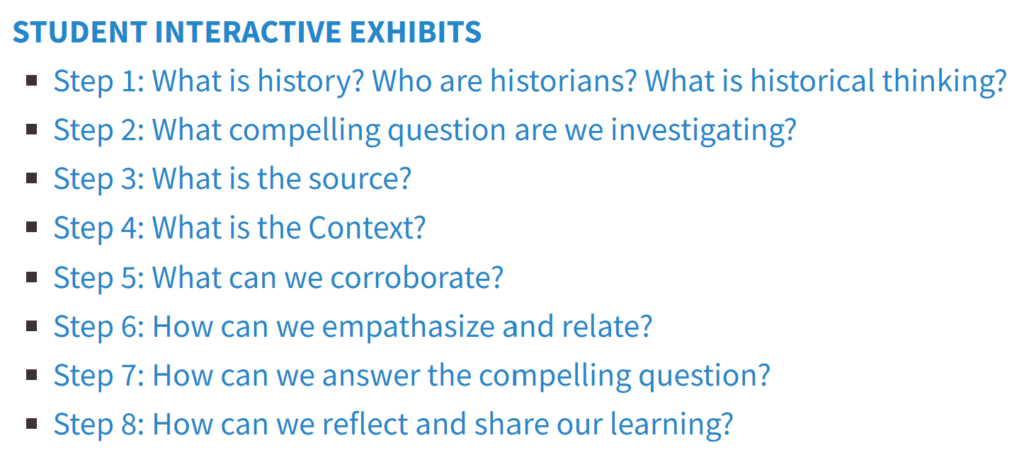
My project idea is to create an introductory historical thinking activity for middle school students. The project is focused on teaching students how to contextualize, source, corroborate and close read. The project also serves as a tool teachers can use and implement in their own classes. I have created a teacher’s guide and most of my student interactive exhibits. Each exhibit serves as a lesson for historical thinking. I have broken the exhibits into steps and have incorporated activities students can complete.

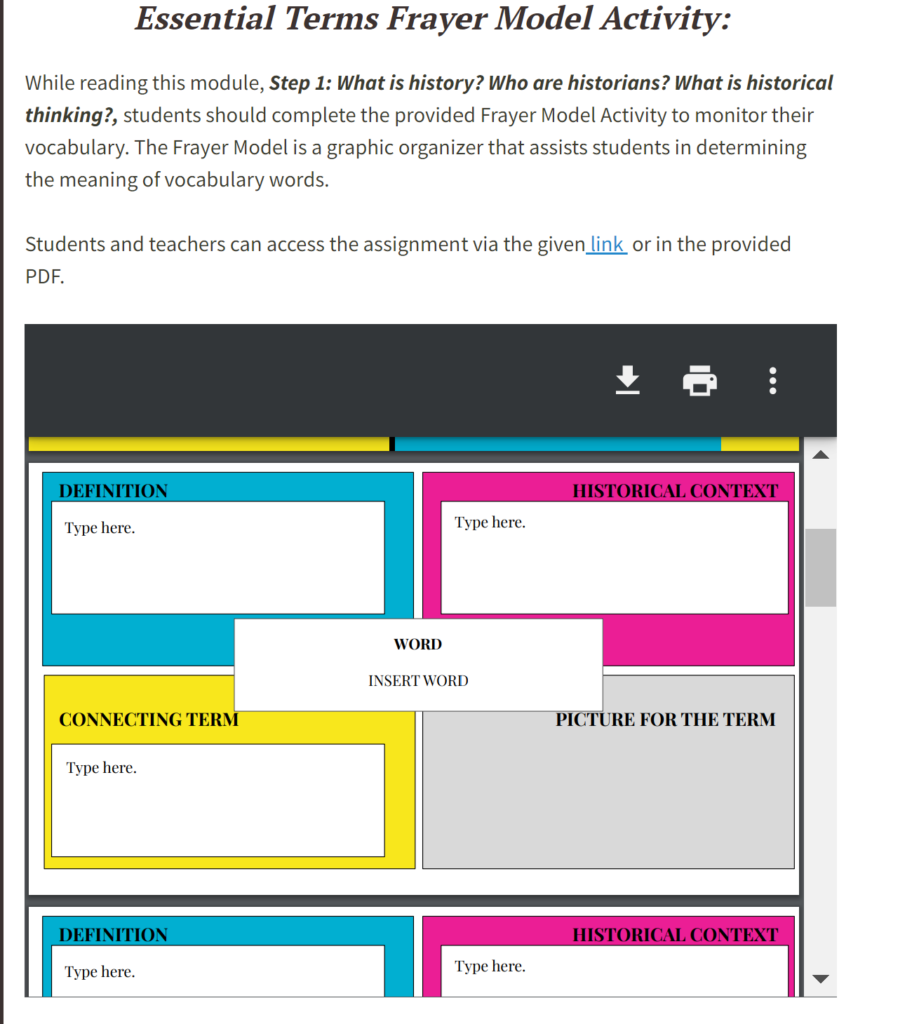
Graphic organizers are used often in order to serve as a Universal Design for learning and a differentiation tool.

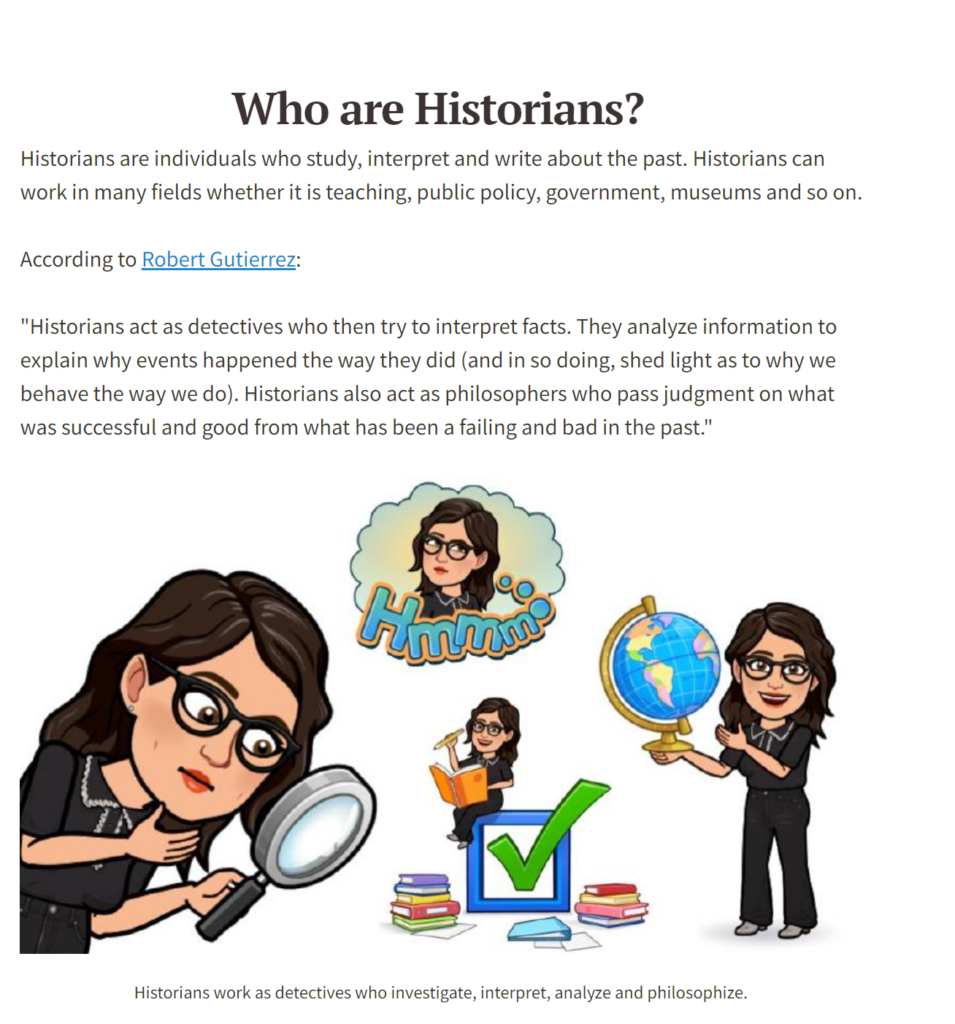
To make my project friendlier to students, I have included videos and guiding images like Bitmojis to provide further direction on the modules and assignments.


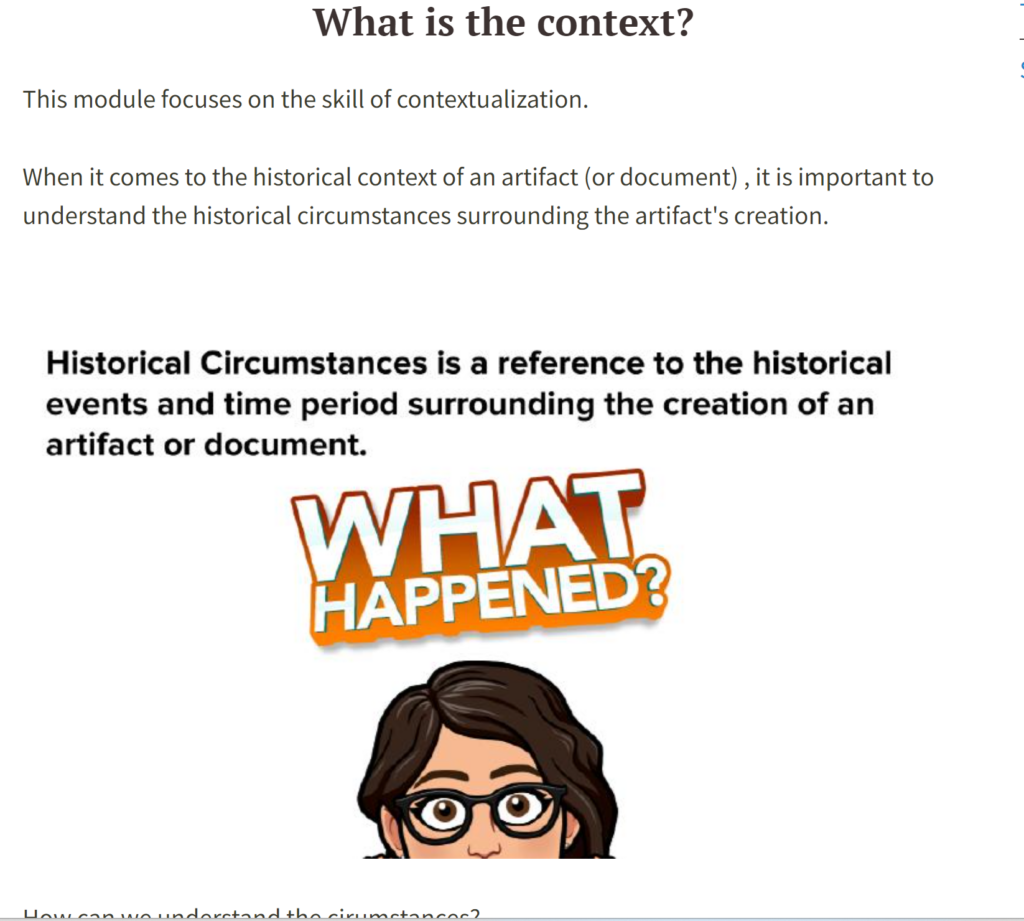
This Bitmoji is used to capture advice on historical context.
I felt that Bitmoji’s served as a friendly way to give students advice on the content.

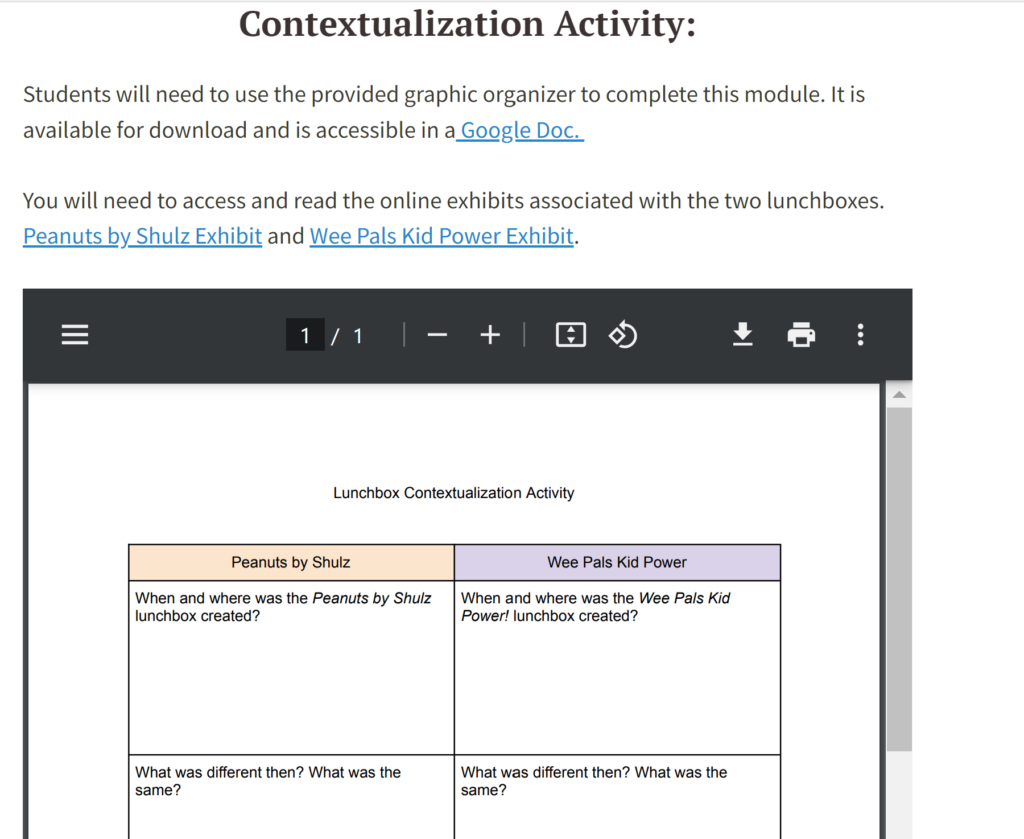
I completed my fourth exhibit related to historical context. I decided to have students identify the context for two lunch boxes that can also be used for a future activity on corroboration. The two lunch boxes are Peanuts by Shulz and Wee Pals Kid Power. I selected these two lunch boxes since Peanuts creator Charles Shulz and Wee Pals creator Morrie Turner were contemporaries and colleagues. Wee Pals was inspired by Peanuts and was created in the midst of the Civil Rights Movement.

Students will complete this graphic organizer to determine contextualization.

I feel as though there are a lot of things students can dig into for historical context with these two artifacts. In my context exhibit, I also provided oral history interviews with Shulz and Turner so students can hear from the cartoonists themselves about the significance of their creation. They also serve as additional multimedia primary sources students can use to eventually answer the compelling question.

These are the videos I am using to show the interviews the cartoonists participated in.

I still need to complete the rest of my exhibits. These exhibits are related to corroboration, empathy, students answering the compelling question and students sharing and reflecting on the activity. I also need to create instructional videos for teachers and students in order to explain how to go through the site.  

I am going to resolve these challenges by just dedicating time to completing the exhibits this week and searching through my district’s resource to reapply them to my exhibits.

I still need to work on my final four exhibits.

Digital humanities issues, tools, and resources