Public history projects are wholly dependent upon a shared authority between audience and content. Public history is an endeavor that is a shared process of history making. Although public history’s definition continues to be a work in progress, it can be redefined as a “society in which a broad public participates in the construction of its own history” (Grele, p.48). This shared process implies that public historians must work with communities to develop the content that will manifest into a public history project. In other words, public history projects belong just as much to the community as it does to the historian as they cannot exist without one another.
According to Frisch, shared authority can be offered as “the interaction of scholarly authority and wider public involvement in presentations of history” (p.53) and the process of doing history with the public can be complex but rewarding. Serge Noiret states “ a public historian confronts and integrates one’s own knowledge listening to public memories and incorporating community documents” (p.55). Co-creating history is dependent on dialogue driven approaches like collaborative reflection opportunities and interviews with members of the public.
Projects like the Chinatown History Museum (CHM) Experiment demonstrate the usefulness of collaborative reflections. The Chinatown History Museum’s mission is to create dialogue-driven exhibitions in order to better explore the “memory and meaning of Chinatown’s past” (p.291). According to John Kuo Wei Tchen, “target segments of the Chinese American community have been collaborating with the CHM planning group in documenting the history of Chinatown and reflecting upon their memories of it” (p.298). The project also involved scholars, museum professionals, and segments of the non-chinese community. As a result, CHM has created exhibitions that incorporate feedback from site visitors who are willing to discuss the themes and details of the exhibit and provide their own “memories, photographs, documents, and personal memorabilia” (p.308).
Interviews are also an important part of public history. Oral Histories allow for individuals to share their personal experiences to past events and ownership is shared amongst the interviewer and interviewee” (Corbett and Miller, p.20). Projects like Through the Eyes of the Child utilized oral history interviews to bring to light local African American History. The goal of the project “was to share both inquiry and authority with the black community, beginning with focus group discussions to determine what kind of museum exhibit that community wanted to see” (p.29). From these discussions, community participants “firmly recommended against an exhibit on civil rights, music, or sports, all of which they regarded as stereotypical at best” (p. 29). Consequently, the final exhibit included “a one-act play and curriculum materials for neighborhood oral history projects, celebrated middle-class community values and reflected them from the museum back to the community” (p. 30).
Without a doubt, public history projects require historians and the community to work together. The collaborations of both parties enable history to become more meaningful and worthwhile to the existing community. Dialogue driven collaborations between historians and the public allow for history to have a shared authority that promotes a shared process of history making.
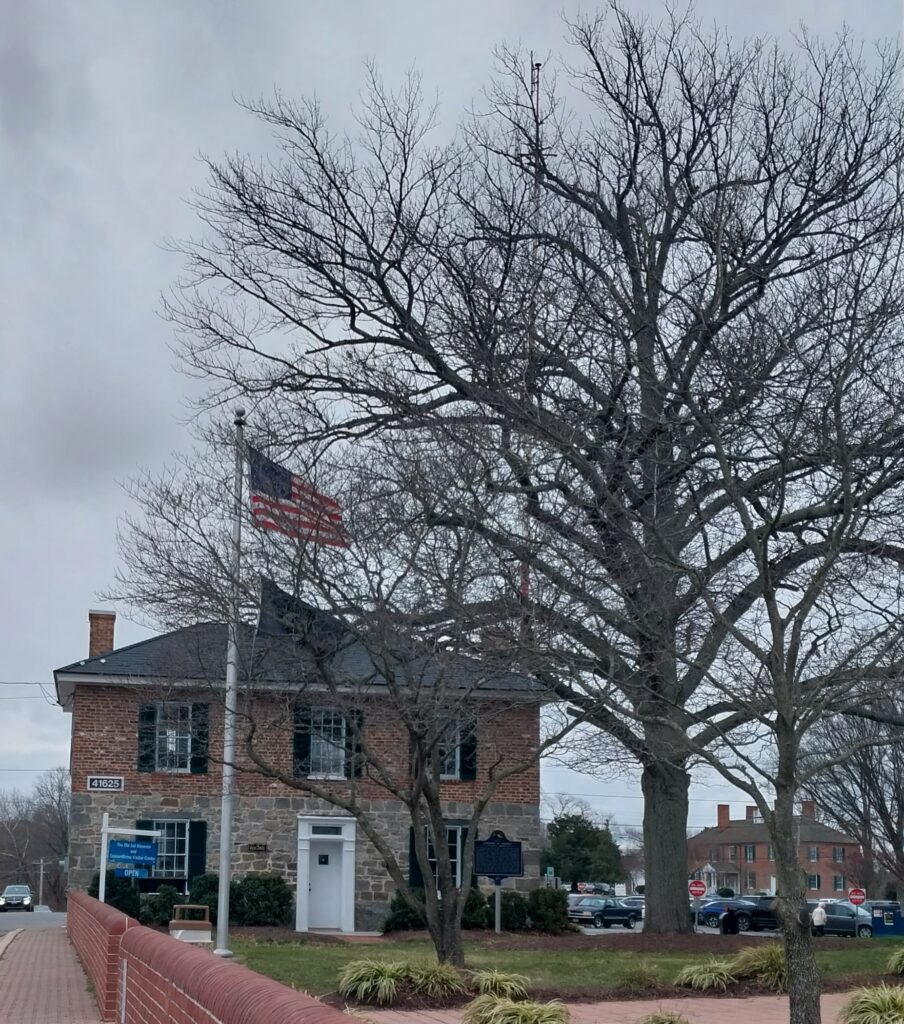
More than one story is tied to Leonardtown, Maryland’s Old Jail Museum. The structure illustrates a “history of jailers, prisoners and its role in the Underground Railroad.” That being said, another historical narrative is also connected to the jailhouse. Well, it is more of a local legend “the life and legend of Moll Dyer the ‘St. Mary’s County witch.’”
A photo of the Old Jail in Leonardtown, Maryland
The Old Jail’s Structure:
The Old Jail is a building that was developed in 1876 to serve as the sixth iteration of the local county jail. The structure is 20 by 25 feet, two stories high and built of stone and brick. The structure’s original layout included two rooms on the first floor that were created for the jailer and their family while the three cells on the second floor were dedicated to holding the prisoners. The prisoners were segregated by gender and race with one cell for all Black prisoners.
The Old Jail’s Layout:
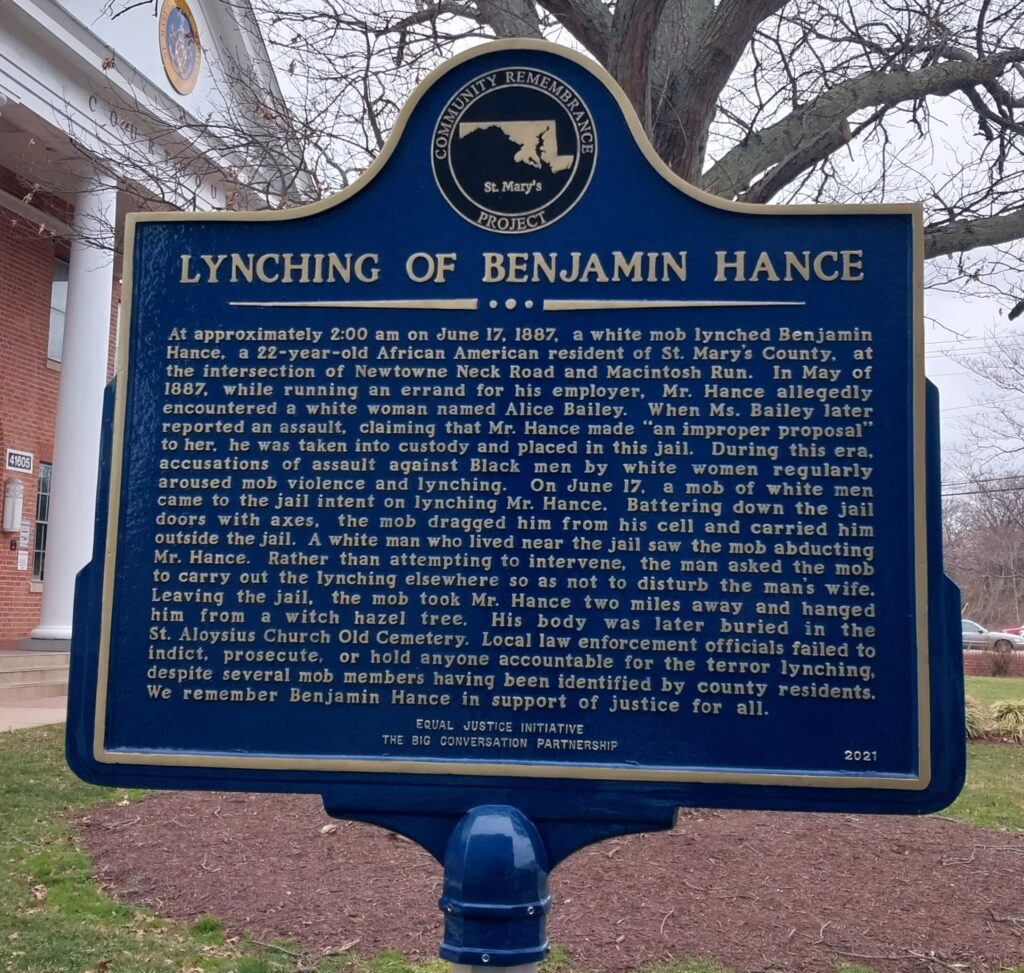
Today, the Old Jail’s layout consists of two rooms on the first floor that serve as the Leonardtown Visitor Center/gift shop and one exhibit that showcases the building’s history. The second floor includes two exhibits that showcase the courthouse’s connection to the Underground Railroad Network to Freedom and the lynching of a Black man named Benjamin Hance. Hance was kidnapped from the 1876 jail and was lynched by a mob of white men on June 17, 1887. The building is located in the center of Leonardtown, sharing a plot of land with the current and functioning county courthouse. A historical marker commemorating the lynching of Benjamin Hance is located in front of the Old Jail.
Historical Marker dedicated to lynching victims.Historical marker for Benjamin Hance
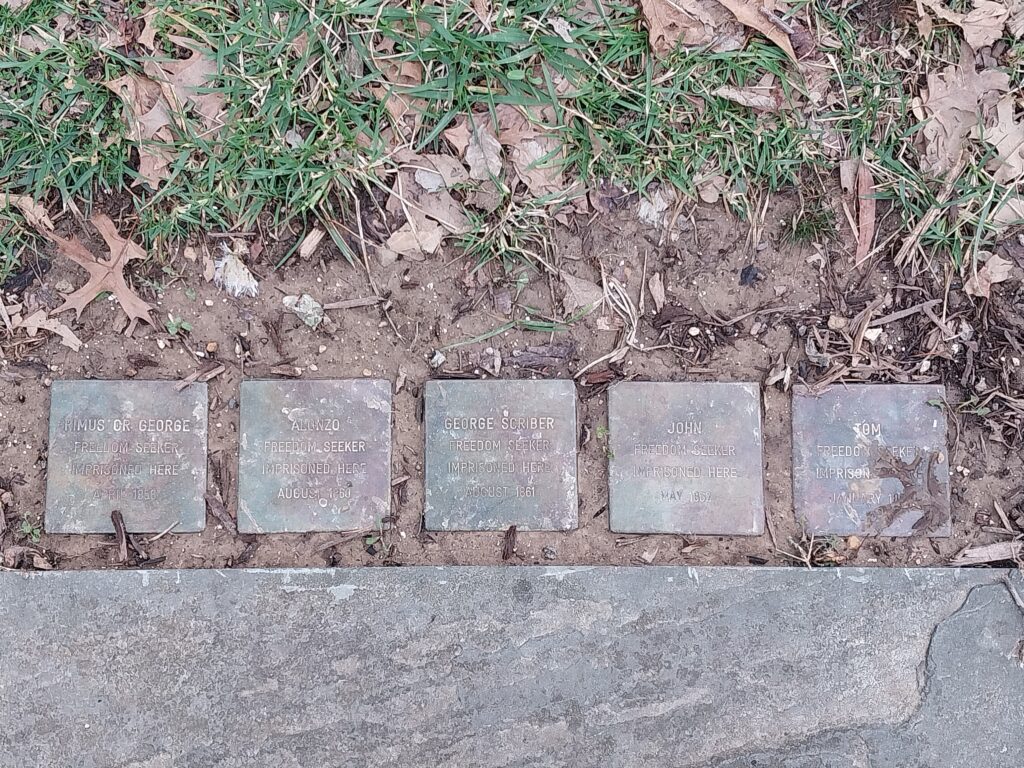
The brick path connected to the front entrance of the Old Jail also pays respect to the runaway slaves who were incarcerated at the Old Jail as the men’s names are engraved in the brick closest to the tree. However, rather than refer to them as runaway slaves in the brick they are referred to as “freedom seekers.”
The names of runaway slaves or in other words freedom seekers are engraved in the brick.
Who owns the Old Jail?
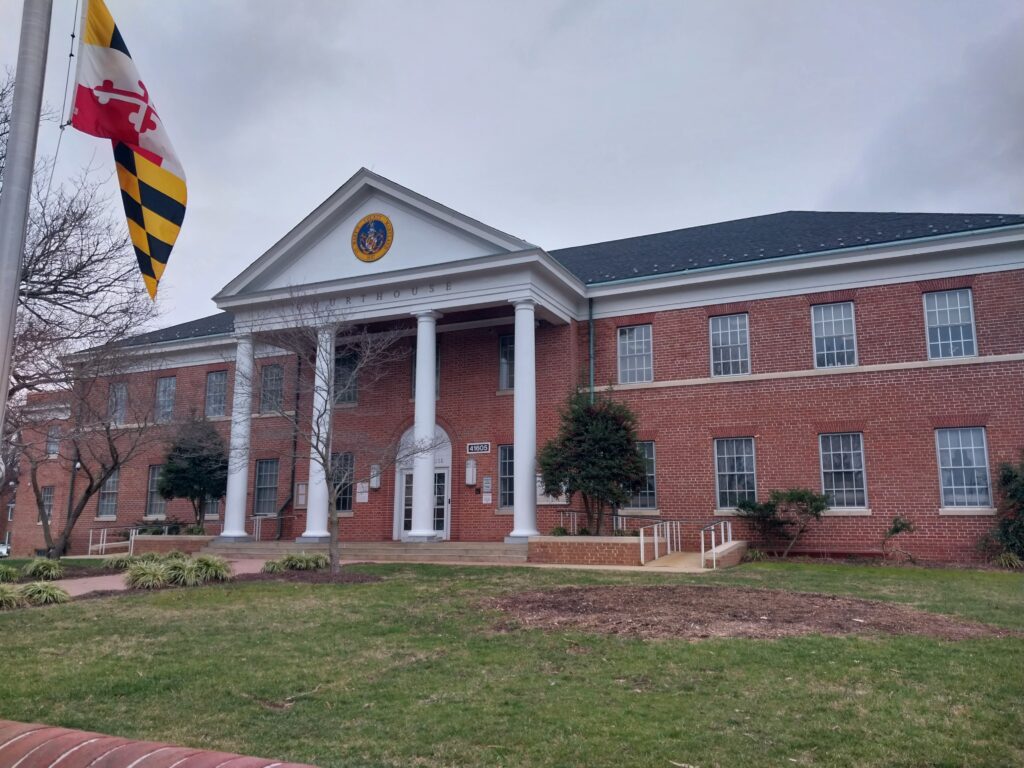
The building itself is owned by the St. Mary’s County government. In 2020, the St. Mary’s County Museum Division took control of the museum’s operations by updating the exhibits and adding the Leonardtown Visitor Center. The Old Jail shares land with the current county courthouse and is located behind historic downtown Leonardtown Square and near the St. Mary’s County Historical Society.
The St. Mary’s County Courthouse.
Leonardtown Square has its own history tied to Maryland’s provincial period as well as a WWI memorial dedicated to town residents. The Square also serves as a shopping center with specialty stores and restaurants. In relation to the St. Mary’s County Historical Society, the Old Jail was once used to house the records of the historical society.
Who is the audience?
The primary audience of the Old Jail are tourists and/or visitors to Leonardtown. Although the building serves a purpose in exhibiting local history a good portion of the building caters to tourists. The Old Jail’s gift shop and visitor center are both used to advertise the town’s attractions, businesses and events. Awkwardly, the Old Jail also brings more than just tourists to its vicinity as it also shares a path with courthouse patrons. Although there is a parking lot behind the jail, the lot is mostly for courthouse employees and visitors. I believe visitors of the Old Jail are meant to walk rather than drive to the location from the town square due to the signage on the sidewalks.
What items are used to communicate the interpretation?
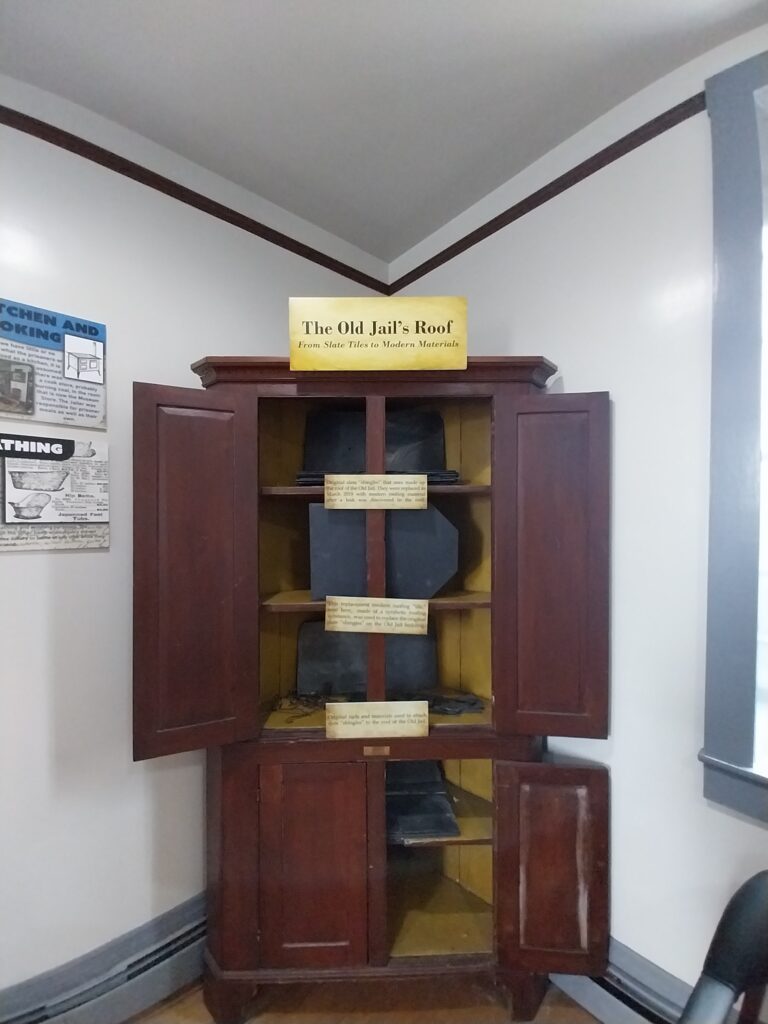
The primary items used to communicate the interpretation of the Old Jail include a 1860s style ballot box, an exhibition of the building’s roof tiles, a brick fireplace, parchment showing wicken symbols, model bunk beds, a 1930s prisoner restraining device, chamber pot and African American art.
The roof tiles.
All of the items illustrate an aspect of history in association with St. Mary’s County and Leonardtown. Information panels and markers are also used to present more information to visitors on all of the presented items. Many items are missing from the exhibits as the location is currently working to create new exhibitions in two of the rooms on the second floor. Glass cases will be used to show off these items once they are ready for the public.The space does not have interactive elements and provides a collection of reading materials. One interpreter resided in the space and was ready to answer any questions about the location while also carrying out the responsibilities of a gift shop clerk.
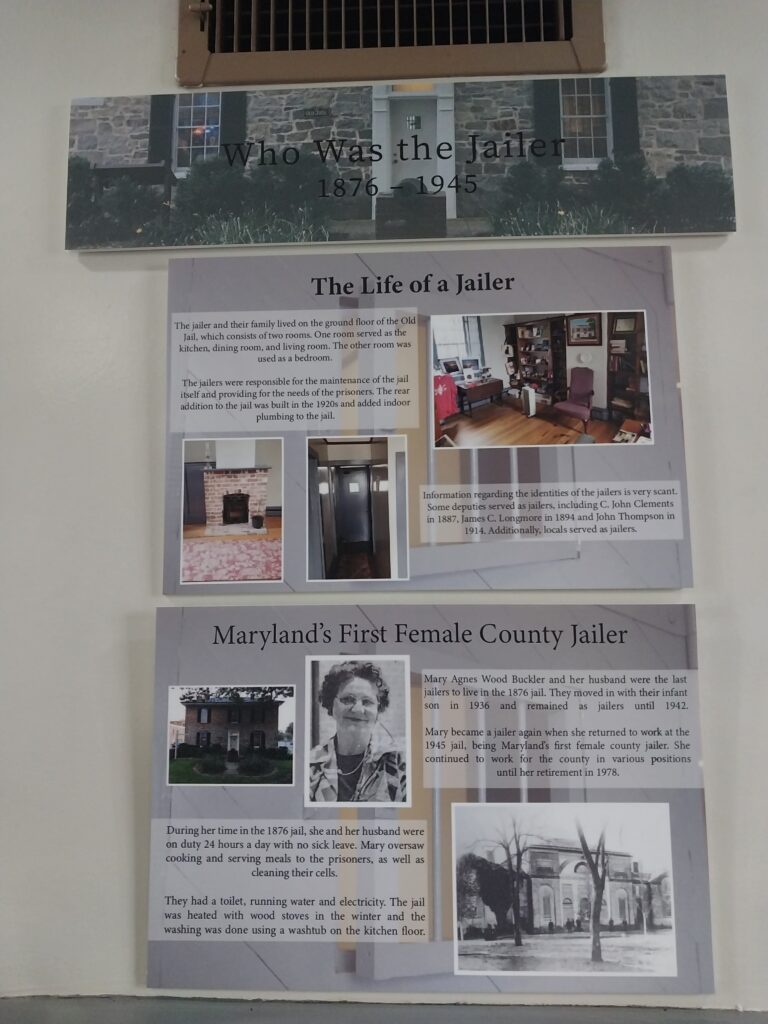
Information on the Jailers and the first female jailer in Maryland.
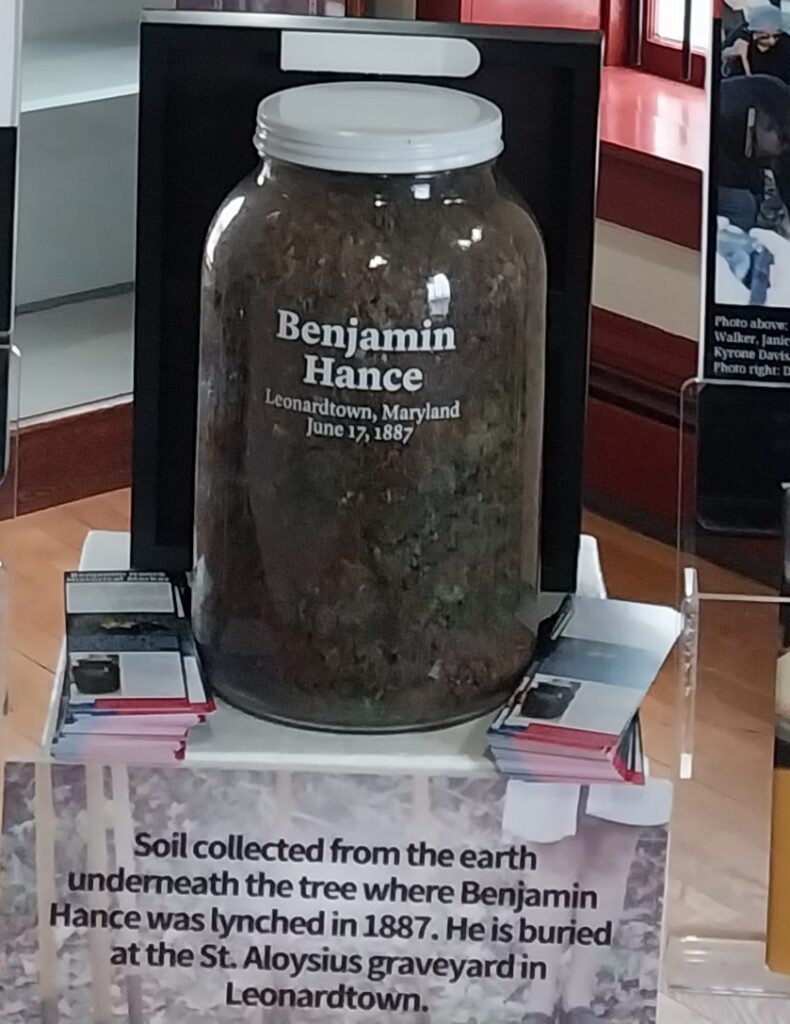
One of the most important aspects of the Old Jail is an exhibit showcasing the jar of soil that was collected during a Soil Collection Ceremony in 2019 to honor Benjamin Hance. The exhibit demonstrates how St. Mary’s County is working in partnership with the Equal Justice Initiative to memoralize lynching victims across the country. Another important aspect of the Old Jail is a timeline that demonstrates how the Old Jail has evolved overtime since its original iteration in 1660 to 2020.
The soil collected in tribute to Benjamin Hance.The Old Jail’s timeline.
The Weaknesses:
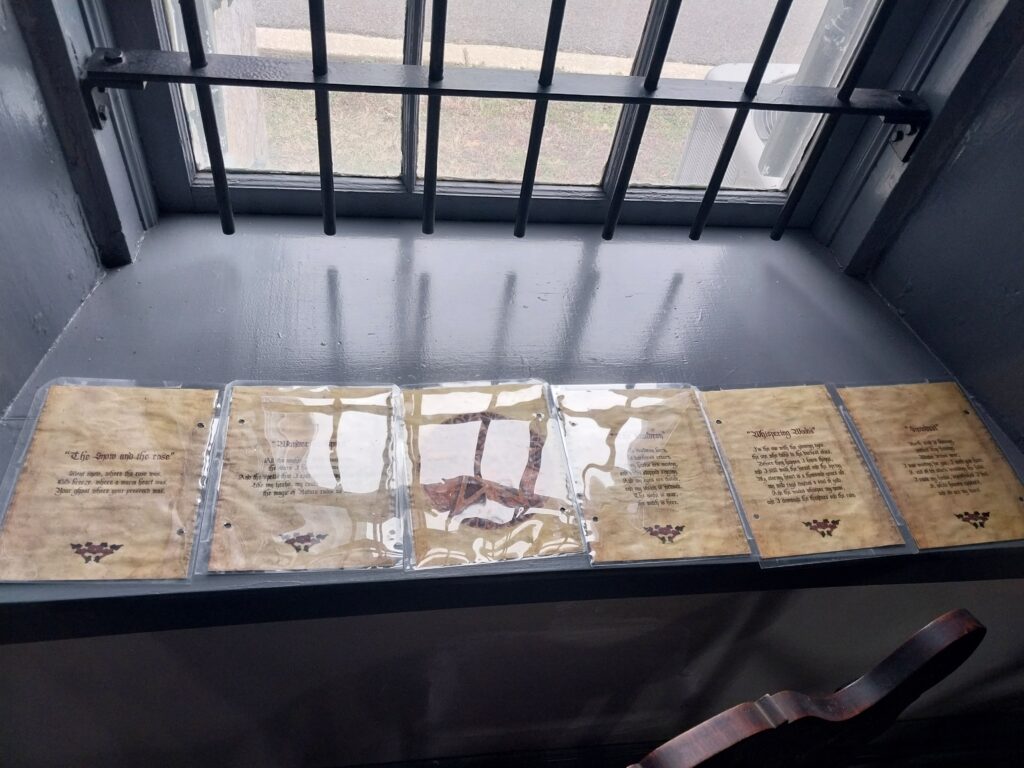
A weakness of the Old Jail is how it tries to connect itself to the “legend” of the town witch Moll Dyer who was in all honesty an herbalist. A window on the first floor attempts to connect to this legend by having parchment paper with wicken symbols and poems about witches laid in front of it. I would remove this from the exhibition and just allow the site interpreter to direct visitors to the St. Mary’s County Historical Society as that location has more relevant information on Moll Dyer. Another weakness of the Old Jail was the lack of physical items in the space. Objects demonstrating the Old Jail’s history should be more apparent in the exhibits that are currently a work in progress.
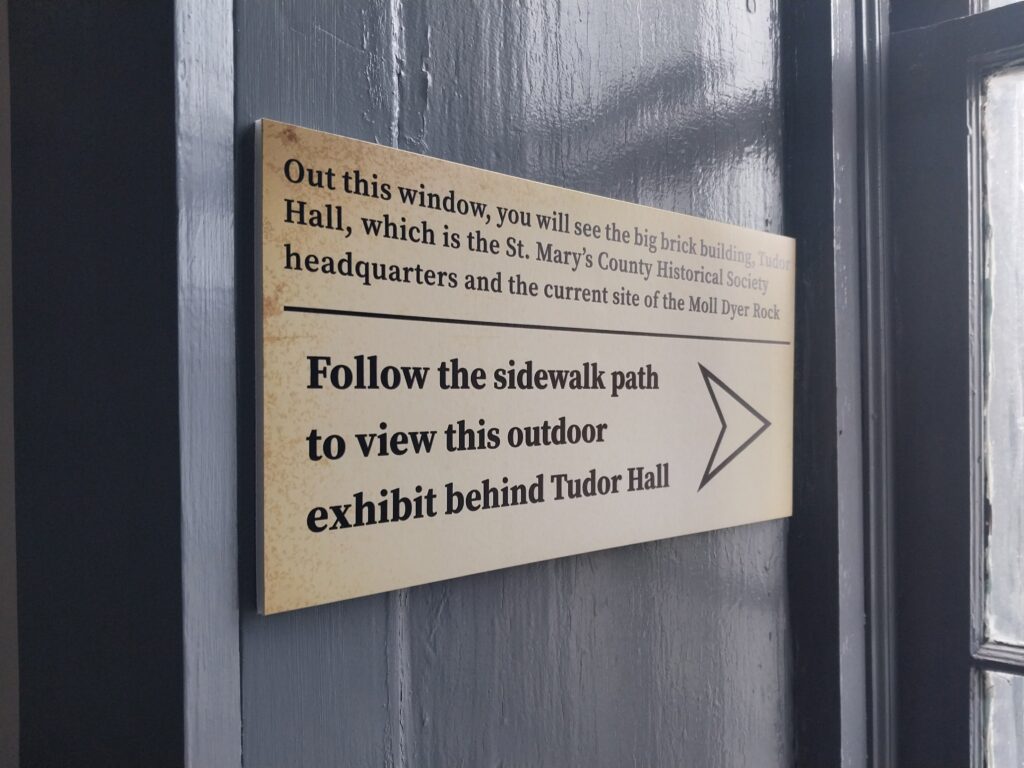
The wicken symbols.Direction to the Historical Society and the Moll Dyer Rock related to the Leonardtown “Witch” Moll Dyer.
The Digital Counterpart:
The digital presence of the site is connected to the St. Mary’s County government’s recreation and park’s museum division. So, if one were to visit the St. Mary’s County of Maryland website the Old Jail would not be the main focal point of the site. In comparison, the Old Jail’s digital counterpart is meant to provide information on the Old Jail and Leonardtown Visitor Center’s hours of operation. The site provides an overview of the museum’s purpose and its connection to the Underground Railroad’s Network to Freedom. The historical argument presented at the physical site is consistent with what is presented digitally. But rather than go into depth about its historical interpretations, the site provides links to other sites that might provide more information to its visitors. For instance, the site provides a link to an article from the Equal Justice Initiative that discusses the placement of the Historical marker dedicated to Benjamin Hance. The site does not provide participatory or interactive elements except clickable links. The site creators cannot be reached unless you fill out an online form to provide information or feedback to the Recreation and Parks agency of St. Mary’s County. I would change the digital experience by providing more information on the Old Jail itself such as a photo gallery, a video tour and a video with a site interpreter. In doing so, the digital site can allow for more historical interpretation that separates itself from the tourist aspect of the Old Jail’s visitor center.
My name is Angela and I attended St. Mary’s College of Maryland to get my Bachelor of Arts Degree in History and Master of Arts Degree in Teaching. I’ve been teaching for four years since and so I have to balance my teaching, planning, and grading with completing the GMU Digital Public Humanities certificate. I’ve just begun my exploration and study of the digital humanities this past August and its been fun. My final project for Introduction to the Digital humanities was the creation of an OMEKA exhibit for my father’s personal collection of retro lunchboxes. It was cool to see the intricacies involved with metal lunchboxes from the 50s to the 80s. My interest in digital public history comes from the fact that I am always trying to find new ways to engage my 8th grade students in history content especially if it is a public history site that is accessible online. My learning goals are to pass the class as well as to learn new skills and content that will lead me to create new materials for my students.
My original definition of digital humanities encompassed the idea that it was a field of study that blended digital tools with humanities materials for the purpose of preservation and accessibility. Since my initial development of this definition, my understanding of the digital humanities has changed. I now understand that my original definition should have included information on how digital tools (computational methods and techniques) are useful in creating new methods for the analysis and interpretation of data.
What would I keep from the original definition?
I continue to maintain that the digital humanities combines digital tools with humanities materials for the purpose of sustainability and increased access. I also mention how the Digital Humanities promotes interdisciplinary collaboration amongst scholars, librarians, archivists, curators and the public. My own personal experience with crowdsourcing, podcasts and open source web publishing deepen this understanding. Crowdsourcing enables volunteers from the general public to engage in cultural research projects through digital platforms such as Wikipedia or transcription services. Members of the public can then work with academics in preserving cultural heritage. In doing so, cultural artifacts are maintained for future generations. Similarly, podcasts make scholarly research more engaging for the general public by utilizing sound design, audio editing, voice acting and narration. These elements combined transform academic works into compelling stories for the average listener that can be retold with time.
In the case of open source web publishing, sites like Omeka enable the creation of digital collections. These digital collections can then be used to preserve the historical memory of various artifacts while also increasing their general accessibility. For example, I created an Omeka site to digitize my father’s collection of retro lunchboxes. I was able to interpret the information presented in the lunchbox collection and note my findings. The website itself creates a record of the lunchboxes in my father’s collection while also enabling me to share the collection with others in online exhibits.
What would I now include in my definition?
The digital humanities is not only important for preserving and increasing access to humanities materials but also for the analysis and interpretation of information. An array of digital tools and computational methods can be used for this purpose. These tools include and are not limited to: AI (ChatGPT), Wikipedia, podcasts, Omeka, text mining, mapping and network analysis software. These digital tools can create visual re-representations of data that then make it easier to distinguish the relationships and patterns prevalent in the research.
How do these tools allow analysis and interpretation?
AI uses a conversational format to re-represent data to then initiate deeper inquiries into various subject matters.
Wikipedia uses crowdsourced knowledge to create articles on infinite subjects that then include hyperlinks to other sources of information. Wikipedia contributors can contribute to each article and utilize the talk features to collaborate with one another on making changes to an article. This then demonstrates the continuities and changes in the subject overtime.
Podcasts utilize theatrical elements and dialogue to re-represent academic knowledge. Podcast hosts and experts can then assist in the interpretation and analysis of primary source information.
Omeka allows for the creation of digital exhibits and collections that can be interpreted and analyzed by the curator and site visitors.
Text Mining software tools allow users to upload links of textual information into data sets to then be processed into a digital corpus. Then, depending on the software, the information can then be adapted into a visual interactive tool that makes patterns in the data more apparent. Voyant is an example of a text mining tool that can be used to transform text into a visual interactive.
Digital mapping software tools can be used to visually enhance uploaded mapping data. In mapping software like kepler.gl, features like points, clusters and heat maps enhance uploaded data for interpretation.
Network analysis software can be used to transform datasets into visual interactives. Tools like Palladio enable users to modify the dimensions, layers, sources, targets, facets, nodes and links of uploaded data for analysis and interpretation.
Final Thoughts:
My initial definition of the digital humanities was quite simple. My experience with digital humanities projects and tools have enlightened me in that now I realize the significance of digital tools in the interpretation and analysis of knowledge. Ultimately, the digital humanities has the potential to use digital tools to transform the way in which knowledge is preserved and accessed over time as well as the way in which it is interpreted and analyzed. That said, as time goes on, I am sure my definition will continue to evolve and improve with experience.
Podcasts are transformative in the way they can enhance digital humanities research that would otherwise be printed in academic papers. Podcasts transform academic scholarly tradition by taking advantage of the theatrical nature of podcasts. Dan Cohen, Vice Provost, Dean and Professor of Northeastern University, praises podcasts for their ability to genre-build as well as their “unparalleled ability to convey the reality of an academic work, and inculcate appreciation of it.” Essentially, podcast elements like sound design, audio editing, voice acting and narration, make scholarly research more compelling for a general audience. Podcasts such as NPR’s Throughline, Consolation Prize, and Ben Franklin’s World demonstrate the effectiveness of using audio design, sound mixing and voice acting in podcasting. They utilize hosts, experts and voice actors and sound effects to help drive the narratives being discussed and make the content more engaging for the listener. These podcast elements enable the listener to become more acquainted and engrossed with the narrative.
Similarly to the radio shows of the mid-twentieth century, podcasts communicate a story that is compelling to the listener. Fortunately, according to Pew Research data, a majority of podcast listeners engage with podcasts for entertainment, learning and diversion. In other words, educational podcasts that share scholarly research are only growing in popularity with the general public.
For the most part, podcasts differ from other tools in that they are more theatrical in the conveyance of academic research. Podcast elements such as sound design and voice acting make text based research more interesting to a general viewer. Podcasts also enable research to become more of a conversation to be had with multiple individuals such as the host of the podcast and the experts. The host helps guide the discussion by providing historical context and guiding questions that will help the listener grasp the narrative that is being told by the expert.
With all that is said with the existing differences, podcasts share a similar role with other data tools residing within the digital humanities. Data tools like Voyant, kepler.gl and Palladio share a commonality with podcasts as they all serve as re-representations of data that can be comprehended and interpreted for people to reach new conclusions about the human experience. While we may not typically conduct an analysis of podcasts, we can use tools like Perusall to annotate what is spoken or done in podcasts to keep track of source and citation information. This can then assist users in pursuing further research on a given topic. AI such as ChatGTP and crowdsourced knowledge projects like Wikipedia also lend themselves to the conversational and discussion style utilized by podcasts. Crowdsourcing projects just like podcasts also engage public audiences with scholarly research in a non-traditional fashion.
According to scholar Trevor Owens, the digital humanities “are at its best when it embraces the digital not simply as a means to the traditional ends of scholarship, but when it transforms the nature of what humanists do.” Fortunately, podcasts fit this understanding as they can drastically change the way in which scholarly research is shared and explored. Scholarly research no longer has to depend on its publication in academic papers but can now be shared in a digital format that can be listened to and shared with everyone to further the digital humanities.
Within the digital humanities, crowdsourcing is the methodology of recruiting volunteers from the general public to engage in cultural research via digital platforms. The purpose of it is to encourage volunteers to work with researchers, archivists and academics to gather information that serves the greater cultural heritage community by gaining and spreading knowledge. Crowdsourcing is best suited for digital projects that involve transcription. Crowdsourcing transcription can be a successful endeavor as long as its digital interface is easy to understand and accessible.
The Library of Congress’ By the People initiative is a perfect example of a crowdsourcing project that is easy to understand and accessible. Users do not have to create an account to begin their transcription services. The project is up front about which transcription projects are in progress and/or completed. The project also provides easy to understand parameters for transcription. Instructions are provided for how users can get started, transcribe, review and tag. A History Hub discussion forum is also provided for users in case they come across additional issues with the transcription process. Additionally, it is helpful that the project staffs a room of professionals who can monitor the platform.
The digital humanities can benefit from crowdsourcing in that it can transform the way cultural heritage artifacts are taught and learned about. For the most part, crowdsourcing allows more people to access artifacts and institutions. Plus, first hand experience with transcription enables volunteers to pursue further knowledge or engagement with a specific subject matter.
Using Wikipedia:
Wikipedia offers its users a unique opportunity to explore the talk and history pages of its articles. The exploration of the talk and view history pages gives users transparency on the creation of Wikipedia articles. Users can ultimately gain insight on the dialogue contributors have on article creation as well as the revising and editing process of Wikipedia pages.
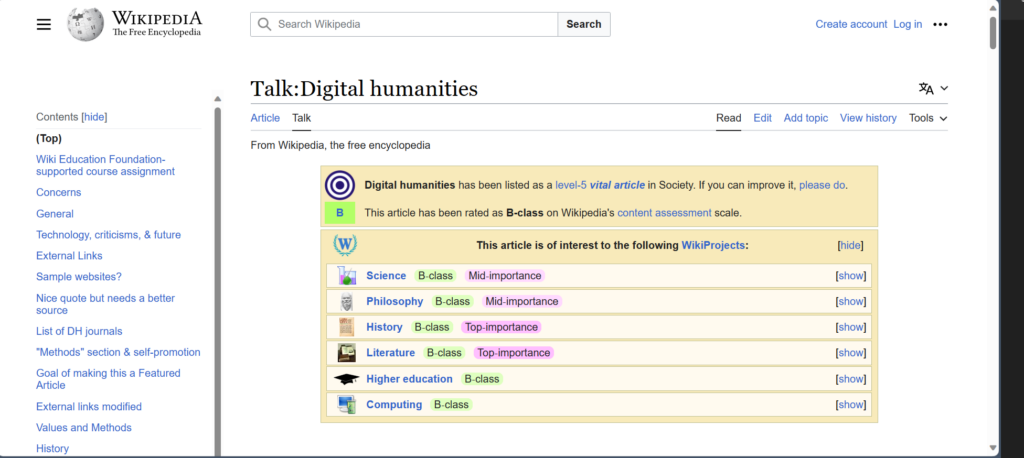
This is the current Wikipedia page for the Digital Humanities. Under the article heading, users can access the “talk” feature to see what dialogue occured with contributors overtime. In the far right, users can access the articles “view history” to see what changes the article had overtime.The “talk” feature allows users to see the discussions Wikipedia contributors had overtime in relation to the Digital Humanities article.
I utilized Wikipedia’s talk and history features in my exploration of Wikipedia’s digital humanities’ article. The talk feature allowed me to see the discussions contributors had over the content that was written. There were apparent issues related to the article’s organization. The article also had numerous contributors who engaged in a dialogue on making improvements to the article’s quotations, external links, neutrality, definitions and so on. Users are also allowed to view the biographies of the contributors. For instance, Skirden and Hectorlopez17 were top contributors for the current digital humanities article. They were both associated with Wikipedia projects like Wikipedian in Residence and the Electronic Textual Cultures laboratory. If the information is public, users can see the identified credentials of the key contributors and their associations. In regard to the history, I could see that the article was first created on January 30, 2006 by contributor Elijahmeeks. Since 2006, the page has evolved to include more information related to the digital humanities such as its definition, history, cultural relevance, project purpose, values and methods, criticism, references and external links.
In the view history, users can see when an article was made. In this case, Wikipedia’s digital humanities article was made on January 30, 2006 by contributor Elijahmeeks.
That said, Wikipedia is not entirely perfect. It is open source which means anyone can access its entries. But, its transparency with features like their talk and history pages enables users to see how ideas related to their articles have changed overtime; therefore, enabling a reliance on user judgment.
Using AI:
Just like Wikipedia, Artificial Intelligence programs are not without their own problems and possibilities. Programs like ChatGPT have weaknesses in citing the location of information they utilize in their response. ChatGPT also generates fictional data points when it does not have enough information to answer an unfamiliar question. ChatGPT also has the potential to oversimplify complex issues due to a lack of human input as it is an AI. However, these flaws can be improved with the implementation of human feedback and plug-in creation.
I used ChatGPT to define the digital humanities. It gave me an extensive answer but did not provide citations for the given response.
According to Jon Gertner, AI companies have made moves to correct AI misinformation by using reinforcement learning with human feedback while the Wikimedia Foundation has created a Wikipedia based plug-in to redirect ChatGPT to Wikipedia for further information on a subject matter. For the most part, AI has the potential to work with users to answer questions in a conversational format that can initiate deeper inquiries into various subject matters. Also, the proposed improvements for AI can lead users into carrying their own scholarly research once AI can provide the necessary citations.
Software tools like Voyant, kepler.gl, and Palladio can be used to create visual rerepresentations of research findings. The tools expand on existing computational methods and techniques. These existing computational methods include textmining, mapping and network analysis. Amongst other similarities, Voyant, kepler.gl, and Palladio can be used to demonstrate the relationships that exists within the research data. Users can upload their digitized research data into the given software to create visualizations of the data. The visualizations will then enable the data to be interpreted and analyzed. However, software tools vary in how they can visually enhance information and what digitization techniques can be used collaboratively.
Voyant is preferred when textmining data. Voyant enables users to upload links of textual information into data sets to be processed into a digital corpus. The digital corpus can then be modified into Voyant’s visual interactive tools like Cirrus, Reader, Trends, Summary and Contexts. For example, I filtered data from the WPA slave narratives to compare the frequency of words in various states. I was then able to conduct a textual analysis of distinctive words based on location. From these tools, users can conduct data analysis to determine relevant patterns and relationships.
Comparatively, kepler.gl is a digitized mapping tool. Users can utilize features like points, clusters and heat maps to enhance uploaded data. The assortment of maps enable the exploration of data point density to illuminate the significance of certain locations. Kepler.gl also offers features like category maps and timelines to demonstrate the changes and continuities that exist over time in a data set. Kepler.gl also enables data differentiation. I was able to use kepler.gl to differentiate the different jobs the enslaved (identified in the WPA slave narratives) were assigned. I was also able to use the timeline feature to see changes in the data overtime to examine the relationships between various locations and their significance in Alabama.
Palladio, a digital network graphing tool, can also be used to create visual interactives. Users can upload data that can be networked within the software. Palladio allows its users to modify the dimensions, layers, sources, targets, facets, nodes and links of uploaded data. With these modifications, users can evaluate the patterns and connections that exist in the data. In my usage of the WPA slave narratives, I was able to identify patterns in the data related to unknown ages of the interviewees by using the provided dimensions.
Clearly, all three software tools are useful in showing the relationships and patterns that exist in uploaded data. But, they differ in what computational methods they can be best utilized. Voyant is preferred for textmining while kepler.gl and Palladio are useful for data mapping. Despite the differences, these three software tools can be used in collaboration to provide various visual interactives that can be used to confirm or deny patterns and continuities in the data. The given software can also be used to draw support for historical interpretations by drawing on the quantitative and qualitative evidence presented in textmining and mapping.
A network graph is a digital diagraming tool that can be used to visually represent the relationships that exist within research data by expanding on current digital tools like OCR, text-mining and mapping. A network graph relies on digitized data, nodes and links to create visual interactives and representations of the given information. From these visualizations, researchers can interpret the patterns that exist in the information. Notably, researchers can use their research data in software like Palladio to create a deeper understanding for their subject matter as well as to determine the relevant connections and inquiries that exist within and from the data.
Wait? What is Palladio?
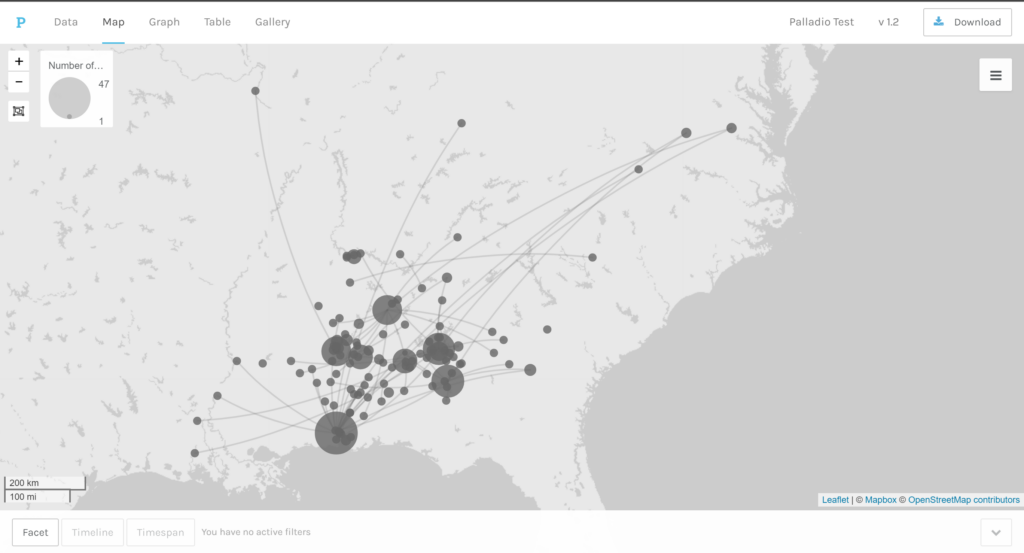
This is the map tool that can be used on Palladio. Palladio allows its users to use nodes and links to highlight the relationships between locations in the data.
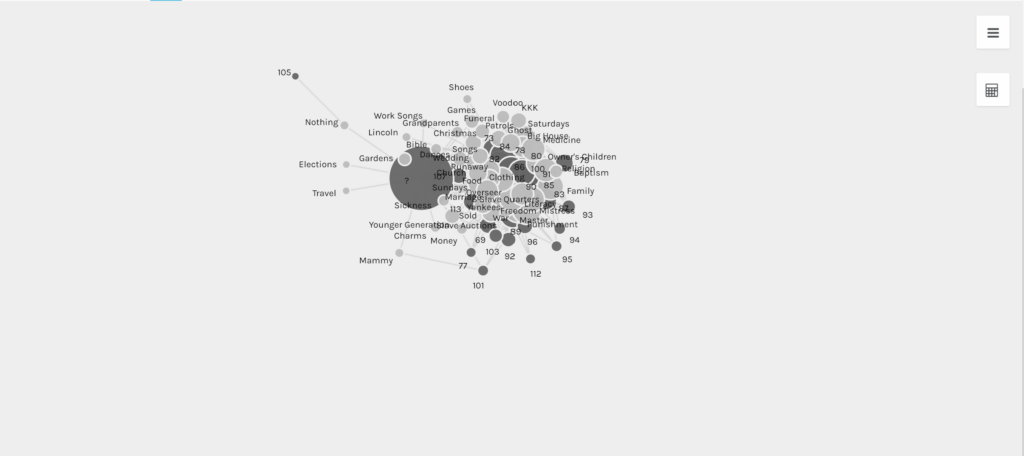
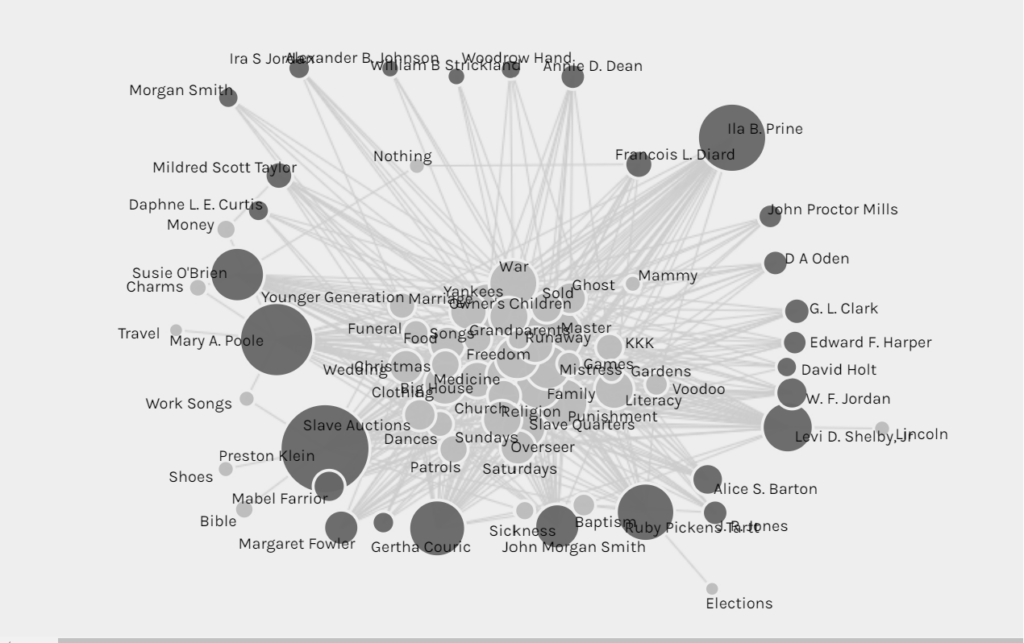
Palladio is a software tool that enables researchers to upload relevant research data from a .csv or spreadsheet that can be networked within the software. From there, Palladio can create visual interactives using nodes and links based on the dimensions, layers, sources, targets and facets set by the user. In my test run of the software, I uploaded data from the WPA slave narratives project. I was able to filter my network graphs based on my selected dimensions such as M/F (Male/Female), Type of Work, Interviewer, Topics, Age, When interviewed and so on. As a result, I was able to see the connections and patterns that existed within the data. For instance, I used the network graph to see that there was a large node associated with ages that were unknown to the interviewers. This led me to the conclusion that many of the former enslaved had no idea what their age was based on a lack of record keeping that occurred on plantations for the enslaved.
This network graph demonstrates the relationship between the age of those interviewed (in the dark gray nodes) and the topics that are discussed (in light gray).This network graph shows the relationship between the interviwers (in dark gray) and the topics that were discussed in the narratives (in light gray).
How have network graphs been used?
Network graphs have also allowed scholars to explore the connections and inquiries associated with the reprinting of texts in the nineteenth century (the Viral Texts Project), the correspondence of Enlightenment thinkers (Mapping the Republic of Letters) and the personal relationships of Jazz musicians (Linked Jazz). The Viral Texts Project demonstrates the culture of reprinting in the nineteenth century as well as the popularity of certain texts and themes in that period of time. Comparatively, the Mapping the Republic of Letters project allows scholars to see the transference of ideas that emerged with the correspondence and relationships of certain historical figures. Similarily, the Linked Jazz project diagrams the relationships of various Jazz musicians by linking documents and data from archives, libraries and museums. Understandably, network graphs enable scholars to learn new insights on the research they currently have.
Digital mapping can be defined as the methodology of using geospatial information to create visual representations of historically significant locations with the purpose of investigating historical processes and relationships (Presner and Shepard, 2016). In other words, digital mapping allows researchers to discover the value of time and place for specific areas. According to Presner and Shepard (2016), mapping can be simply understood as “a kind of visualization that uses levels of abstraction, scale, coordinate systems, perspective, symbology, and other forms of representation to convey a set of relations” (p. 1). However, the digital humanities have revolutionized mapping from its most basic form to alternative and improved versions. For instance, mapping now includes historical mapping of “time layers”, linguistic and cultural mapping, conceptual mapping, community-based mapping as well as the use of technology to create visual interactives (Presner & Shepard, 2016). This revolutionization of mapping enables scholars to have a new method of research that can “test hypotheses, discover patterns, and investigate historical processes and relationships”(Presner & Shepard, 2016, p.8).
Several projects have emerged in light of mapping advancements such as Photogrammar, Histories of the National Mall, and Mapping the Gay Guides. Each project expanded on the original understanding of its subject matter. Photogrammar reimagined the scale in which the Great Depression impacted most of America and not just what occured in rural America. Histories of the National Mall provides tourists and site visitiors “compelling stories and primary sources that together build a textured historical context for the space and how it has changed over time.” Mapping the Gay Guides provides six decades worth of insight on businesses and locations that were friendly to the gay community.
Online mapping tools such as kepler.gl further demonstrate the ways in which digital mapping can illuminate historical questions and relationships. Kepler.gl has many features that enable the use of point, cluster, and heat maps along with the use of filters to demonstrate key aspects of information from uploaded data. Points maps can give us a basic understanding of what areas a researcher should focus on. Cluster maps can show us the density of data points and a general area of focus while heat maps can give data specifics on location. Kepler.gl also offers a category map and timeline feature to differentiate given data with categories and to demonstrate changes in the data over time. My original understanding of digital mapping included the idea that it could be used to conduct an analysis of geographic information. Tools such as kepler.gl have the ability to conduct data analysis and interpretation in various mapping styles and features.