American Virtue and Honor
In committing treason, Arnold had lost both virtue and honor. In eighteenth-century
terms, virtue “was an ideal marked by curtailed personal concerns with self-interest, ease and safety” meaning that Americans understood that “liberty could be secured only by the sacrifice of personal interest in support of the public good.”67
Gordon S. Wood’s work has illuminated clearly the meaning of virtue to this generation. It was, Wood writes:
truly the lifeblood of the republic, the thoughts and hopes surrounding this concept of public spirit gave the Revolution its socially radical character-an expected alteration in the very behavior of the people, “laying the foundation in a constitution, not without or over, but with the subject.”68
American honor, just like virtue, was another founding principle for the early American republic. Craig Bruce Smith states that at the time of revolution “honor in America changed from a distinctly British concept into something that was more ethically centered as a nascent protonationalism developed in the new United States.”69 Smith also argues that the “patriots felt that British policy had attacked their honor, and they were forced to react. America would win or lose
based on its ability to maintain its virtue.”70
American notions of virtue and honor not only shaped the path to the American War for Independence but they also “became the guiding principles behind fighting it.”71
Wholeheartedly, it was important for civilians and members of a martial society to partake in the war effort with honorable and virtuous behavior. The Continental Congress even took an active role in encouraging the preservation of honor and virtue as vital to the success of the United States in times of war and peace. However, if Americans failed to be paragons of virtue they would then be unable to justify “their admonishments of Great Britain for having lost these same
ideals.”72
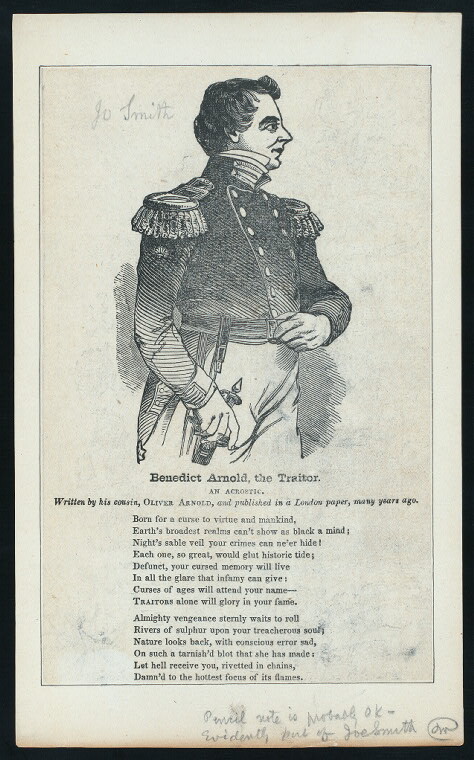
An acrostic poem is used to criticize Arnold for his treason. His virtue is questioned and his name will be forever blackened in history.
When Arnold committed treason he had extinguished both virtue and honor by giving into his self-interest. As a result, he had “galvanized the [American] population to once again champion national honor as the highest goal, while labeling personal interest as selfishness that could lead to treachery and dishonor.”73 In light of Arnold’s treason, Washington seized the opportunity to emphasize anew the importance of American honor and virtue:
Great honor is due to the American Army that this is the first instance of Treason of the kind where many were to be expected from the nature of the dispute and nothing is so bright an ornament in the character of the American soldiers as their having been proof against all the arts and seduction of an insidious enemy.74
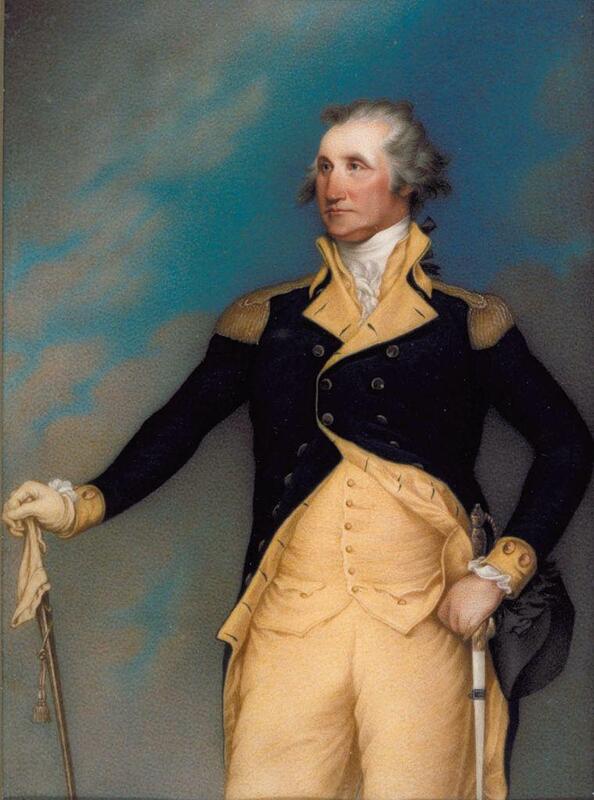
In his denunciation, Washington exemplified what it meant for the American army to be honorable and virtuous by not giving into British temptations. At this time George Washington himself was used in stark contrast to Benedict Arnold, championed as a moral hero whereas Arnold was a villain.
Alan Fine and Lori J. Ducharme explain:
While Arnold was condemned as a demonic traitor to the American cause,
Washington embodies all those elements central to public virtue: piety authenticity of character, success without ambition, moderation and frugality, heroism thatconquered personal shortcomings and subordination of private interest to the public good.75
Juxtaposing Arnold with Washington served to enhance Arnold’s villainy. Arnold was portrayed as having the characteristics of “avarice, moral impurity, and lack of faith,” whereas Washington was held in the highest regard as an example for all Americans to follow.76 Arnold now represented “the worst crimes against virtue;” his treacherous example therefore influenced how “his contemporaries defined themselves, their values and their goals.”77
In 1780, Arnold came to exemplify the antithesis to American virtue and honor in order to ensure American allegiance. The conceptualization of American treason law during these years was originally conceived as a means to crush the dissent of loyalists and push for the obedience of neutral American inhabitants to the side of the revolutionaries. By defining treason, the Founders also emphasized American virtue and honor in creating the ideal American citizen and of course no “true” American citizen would be so lacking in virtue to commit treason. In 1780, the victory of the United States over the British was unforeseeable due to waning morale and popular fervor, low enlistment numbers and British victories in the Southern theatre. Consequently, as a solution, Washington and his fellow officers pounced on the opportunity to make an easily identifiable example out of Arnold as a means to champion true American virtue and honor.